
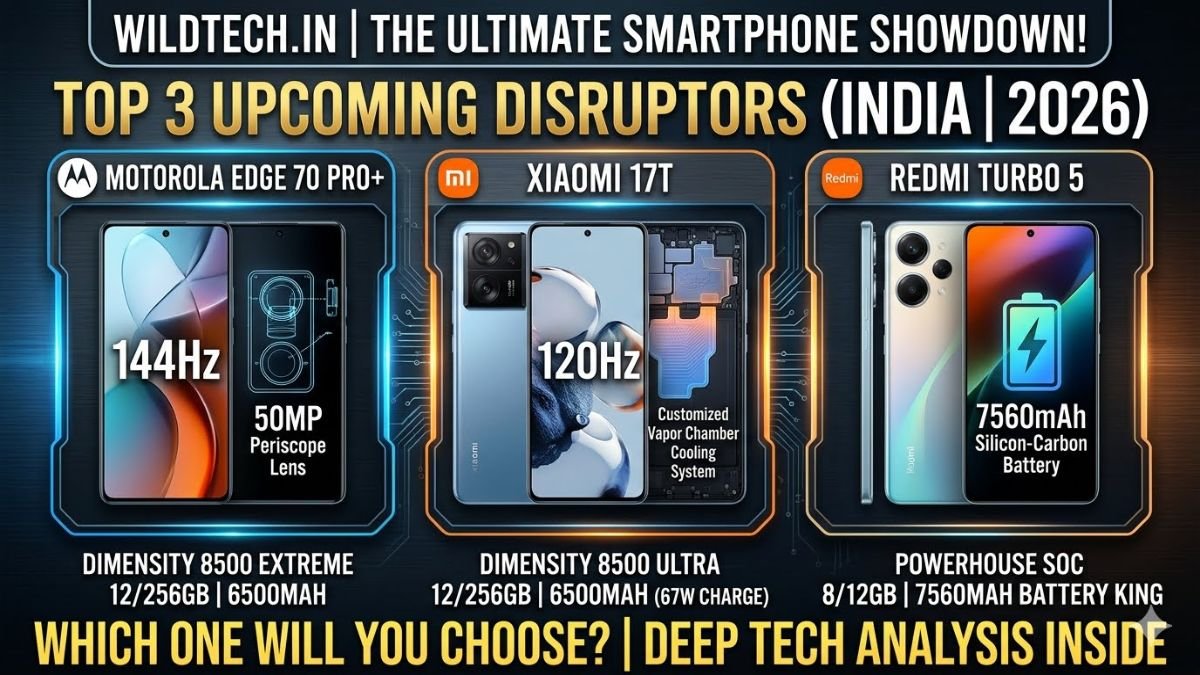
Upcoming Smartphone Launches : Explore the ultimate technical evaluation of India’s highly anticipated smartphone launches, featuring comprehensive insights, deep specifications, and market analysis of the Upcoming Smartphone Motorola Edge 70 Pro+, Xiaomi 17T, and Redmi Turbo 5.
The Indian smartphone landscape is experiencing an intense wave of technological evolution. As mobile consumers increasingly demand tier-one hardware specifications at competitive price matrixes, global smartphone manufacturers are aggressively refreshing their product lineups. The upcoming deployment cycle brings highly anticipated configurations designed to rewrite benchmarks in processing power, display limits, mobile optics, and battery charging infrastructure.
1. Motorola Edge 70 Pro+: The New Premium Flagship Benchmark
Motorola’s strategic return to premium tier leadership relies heavily on its ultra-premium Edge series. The upcoming Motorola Edge 70 Pro+ focuses on blending flagship processing velocity with absolute software cleanliness—a segment often neglected by competitors deploying ad-heavy custom interfaces.

Processor and Computing Metrics
The computational engine driving the Edge 70 Pro+ is the advanced MediaTek Dimensity 8500 Extreme system-on-chip (SoC). Fabricated on an elite 4nm architecture, this processor features high-performance ARM Cortex execution cores designed to handle sustained multi-threaded rendering tasks effortlessly. Paired with high-bandwidth LPDDR5X RAM and lightning-fast UFS 4.1 internal storage, the device minimizes read-write latency, making app installation and system boots nearly instant.
Advanced Display Engineering
The smartphone features a beautiful 6.8-inch 1.5K AMOLED display integrated with a blazing-fast 144Hz refresh rate. For extreme outdoor usage under harsh direct sunlight, the panel pushes an industry-leading peak brightness of up to 5,200 nits, safely protected by Corning Gorilla Glass.

Optics Architecture
Motorola introduces a powerful quad-camera array led by the highly regarded 50MP Sony LYT-710 primary sensor equipped with Optical Image Stabilization (OIS). More importantly, the system incorporates a dedicated 50MP periscope telephoto lens supporting 3.5x optical zoom, offering sharp structural details without suffering from the heavy pixelation commonly seen in digital zoom algorithms.
2. Xiaomi 17T: Elevating the Mid-Premium Experience
Xiaomi’s T-series has long represented a balanced sweet spot, offering flagship-level internal components at a reduced cost structure. The Xiaomi 17T marks a critical return to this philosophy in the Indian market.
Core Architecture and Mechanics
The device operates on the MediaTek Dimensity 8500 Ultra chipset, a customized variant meticulously optimized for advanced on-device artificial intelligence tasks and balanced thermal efficiency. Supported by a massive baseline configuration of 12GB RAM and 256GB storage, the computational backbone effortlessly prevents memory bottlenecking even during high-resolution video exporting cycles.

Visual and Power Systems
The front display utilizes a flat 6.59-inch 1.5K LTPS display panel running at a seamless 120Hz refresh rate. To support extended screening times, Xiaomi packs an ultra-high-density 6500mAh lithium-polymer battery cells. This extensive reservoir is sustained by 67W fast charging technology, ensuring safe and controlled power replenishment cycles without putting excessive thermal stress on the battery.
3. Redmi Turbo 5: High-Velocity Performance Optimization
For the performance enthusiast operating on a strict budget, the upcoming Redmi Turbo 5 focuses almost exclusively on raw execution speeds and extreme battery stamina.
Battery Technology Innovation
The defining engineering highlight of the Redmi Turbo 5 is its massive 7,560mAh high-capacity battery layer. By utilizing advanced silicon-carbon anode materials, Redmi has successfully integrated this massive capacity into a surprisingly slim body profile, effectively removing low-battery anxiety for multi-day field operations.

Targeted Demographic
This smartphone cuts down on unnecessary cosmetic aesthetics to maximize processor performance per rupee. It features a reliable custom cooling system and a dedicated gaming optimization engine, ensuring minimal frame drops during long competitive gaming matches.
Comprehensive Specifications Comparison Matrix
| SmartPhone Model | Primary Processor Architecture | Memory & Storage Specs | Display Panel Capabilities | Power Delivery Infrastructure |
|---|---|---|---|---|
| Motorola Edge 70 Pro+ | Dimensity 8500 Extreme (4nm) | 12GB LPDDR5X / 256GB UFS 4.1 | 6.8″ 144Hz AMOLED, 5200 nits Peak | 6,500mAh / 90W Wired + 15W Wireless |
| Xiaomi 17T | Dimensity 8500 Ultra (4nm) | 12GB LPDDR5X / 256GB UFS 4.1 | 6.59″ 120Hz LTPS AMOLED, 3500 nits | 6,500mAh / 67W Fast Power Delivery |
| Redmi Turbo 5 | High-Velocity Tier SoC | 8GB/12GB RAM Baseline | 120Hz High-Refresh OLED Panel | 7,560mAh Silicon-Carbon Battery Cells |
Q1. What specific software support cycles can buyers expect from these new devices?
Ans: Software longevity has become a key deciding factor for consumers. The Motorola Edge 70 Pro+ ships with Android 16 out-of-the-box and guarantees three major OS platform upgrades along with five full years of security patches. Xiaomi and Redmi devices run their refined HyperOS system, guaranteeing up to 4 years of continuous security deployments.
Q2. Why are manufacturers transitioning to 1.5K resolution displays instead of standard Full HD+?
Ans: A 1.5K display resolution offers the ideal engineering compromise between extreme visual crispness and battery preservation. It provides a noticeably sharper viewing experience than standard 1080p Full HD+ screens, yet consumes far less power than a resource-heavy 2K or 4K panel, keeping the processor efficient.

Q3. Do these newly launched premium smartphones support eSIM features in India?
Ans: Yes. Both the Motorola Edge 70 Pro+ and Xiaomi 17T feature advanced dual-SIM capabilities that fully support programmable eSIM profiles alongside a standard physical Nano-SIM slot. This allows you to smoothly manage multiple carrier networks simultaneously.
Q4. How does the camera setup of the Motorola Edge 70 Pro+ compare to typical budget systems?
Ans: Unlike budget smartphones that integrate cheap 2P auxiliary macro units for marketing numbers, the Motorola Edge 70 Pro+ features true high-grade camera sensors across the board. Every single lens—including the ultra-wide and the periscope telephoto zoom—uses a full 50-megapixel pixel array, ensuring complete clarity across all focal lengths.
Strategic Technical Conclusion Smartphone
An analytical view of the upcoming product deployment shows clear separation among the top contenders. The Motorola Edge 70 Pro+ is undeniably built for the elite user who demands clean Android software, ultra-fast 144Hz screen fluidness, and advanced periscope zoom photography. The Xiaomi 17T offers a balanced, long-lasting setup perfect for daily workflows. Meanwhile, the Redmi Turbo 5 remains the absolute go-to choice for users whose top priority is unparalleled battery longevity.



VK Singh is an Editor and Content Writer with 4+ years of experience in technology, automobile, and trending news writing. She is passionate about creating accurate, informative, and reader-friendly content. At WildTech.in, she covers the latest updates on cars, bikes, smartphones, gadgets, and technology trends, helping readers stay informed with reliable and easy-to-understand information.